FEATURED STORY
Filtering the Future:
Undergrad Researchers Explore the Steps to Dialysis Technology
By Megan Knox '24
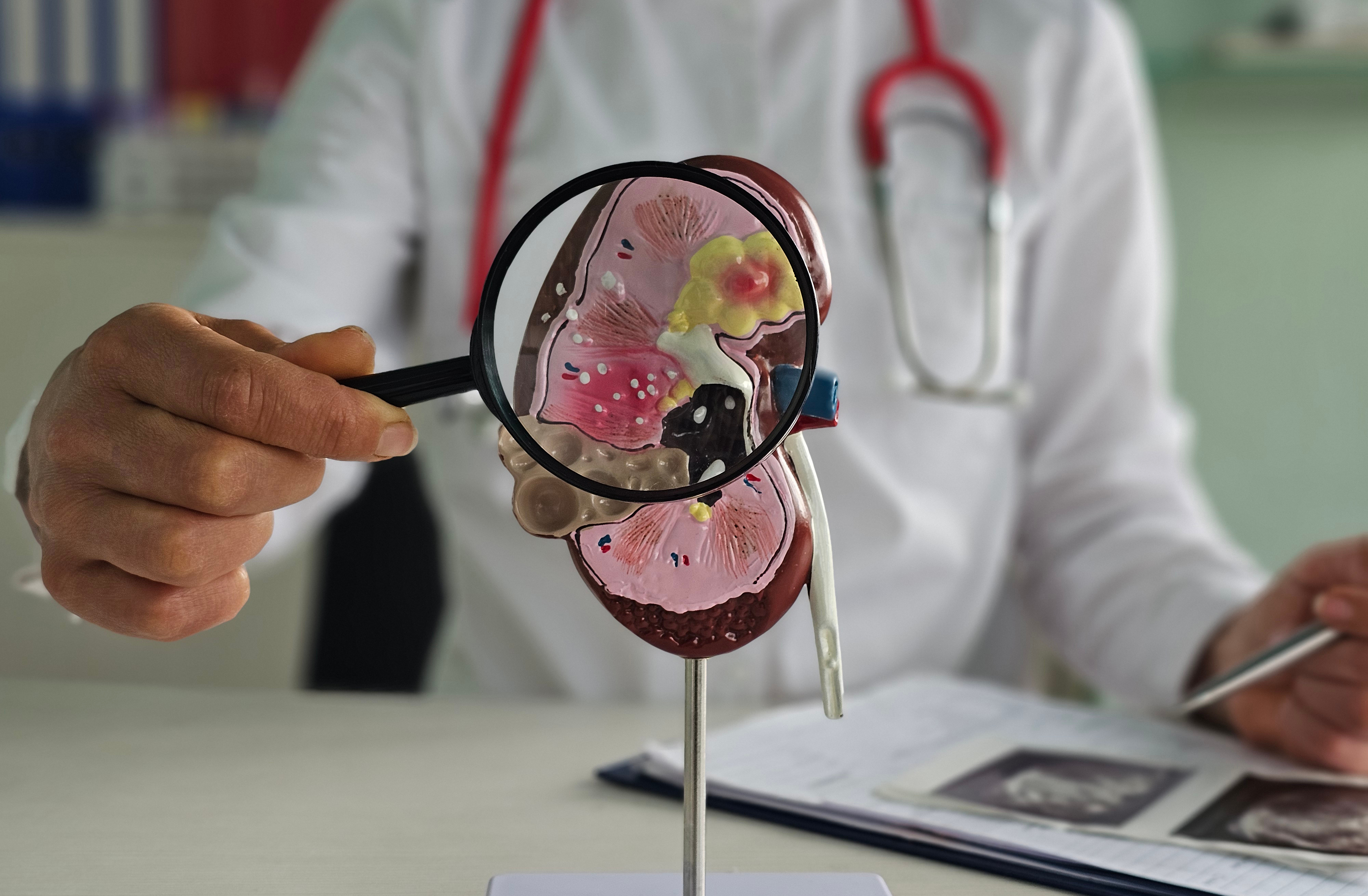
In the chemistry labs at Frostburg State University, undergraduate students are getting an introduction to one of the most significant hurdles in biomedical engineering -- making wearable artificial kidneys a reality. Presented at this spring’s Undergrad Research Symposium, a series of students mentored by FSU Chemistry Lecturer, Dr. Fayan Meng, displayed their findings on innovative nanomaterials capable of filtering waste from the blood.
Students Nathaniel Poulin '26, Owen Sealy '26, Ty Kashporenko '26 and Juleka Sergent took on the challenge as a foundational platform for learning basic laboratory research. To fully understand the work of this team of scientists, it helps to understand the mechanics of dialysis. In the medical field, dialysate is a specially prepared fluid used during dialysis. Meng explained the process of a conventional hemodialysis system.
Traditional dialysis machines use large volumes of dialysate and discard the fluid after use. A wearable system, however, would require a much smaller volume of fluid that is continuously cleaned and reused. Filtering urea out from the spent dialysate is difficult because urea is a small, stable and highly water-soluble molecule. The Wearable Artificial Kidney (WAK) is designed to provide continuous dynamic dialysis for uremia patients. Guided by Meng, the team used the challenge of removing urea from spent dialysate as a meaningful real-world application through which the students could learn how scientific research begins.
Using prepared urea solutions as simplified laboratory models, these undergraduates set out to test whether specific nanomaterials could interact with and trap urea molecules. They focused their experiments on two primary jobs: Multi-Walled Carbon Nanotubes (MWNTs) and Molybdenum Disulfide (MoS2). Because nanomaterials have a large surface area relative to their mass, they act like microscopic sponges where waste molecules can potentially attach.
Kashporenko and Sergent evaluated unmodified carbon nanotubes versus modified derivatives. In their study, the unmodified carbon nanotubes tend to be hydrophobic and showed little to no urea absorption in solution. By adding carboxylic acid groups (–COOH) to the nanotube surface, this modification provides additional chemical handles that may help the surface interact with urea.
Sealy and Poulin turned their attention to MoS2, a layered material with different surface and edge characteristics. Their projects investigated whether this material could absorb urea and how adsorption changed over time. In Sealy’s study, he measured absorbance at 10-minute intervals for 60-minutes, while Poulin measured in 24-minute intervals for 2 hours.
“The students collected measurements at different times to observe how the urea concentration changed and whether the adsorption began to reach equilibrium,” Meng said. “The different time intervals reflected the exploratory nature of their individual projects and helped them learn how experimental conditions affect the data.”
Meng is quick to point out that these small-scale experiments are merely steppingstones rather than for clinical or medicinal use. Moving from laboratory models to an actual medical device requires extensive future research including biocompatibility, toxicity testing, particle release, chemical leaching, sterilization, long-term stability and performance after repeated use.
However, the real success of the projects lies in the immense growth of the student researchers.
“I am very proud of Nathaniel, Owen, Ty, Julaka and the other undergraduate students involved,” Meng said. “The most important outcome was their development as beginning researchers. They gained hands-on laboratory experience, learned that research often requires repeated experiments and troubleshooting, and began to understand how fundamental chemistry can contribute to a larger scientific problem.”