
Frostburg State University’s Chamber Orchestra Presents “Celestial Journey” May 6
Apr 24, 2026 8:00 AM
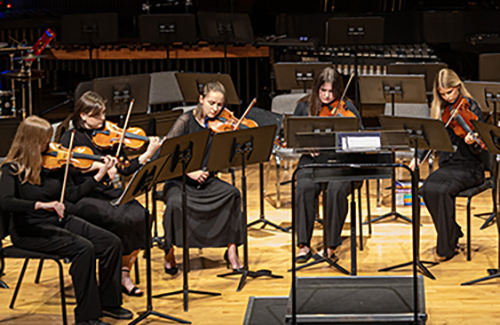 The Frostburg State University Chamber Orchestra is proud to present its program, “Celestial Journey,” on Wednesday, May 6, at 7:30 p.m. in the Pealer Recital Hall of the Woodward D. Pealer Performing Arts Center. The recital is free and open to the public. It will also be live-streamed; follow the link at www.frostburg.edu/concerts.
The concert program will feature “Mars” and “Jupiter” from the suite by Gustav Holst, “The Planets.” This masterwork, composed between 1914-1917, received its premiere performance on September 29, 1918. Since then, the composition has had far reaching influences in popular culture and cinematic film scoring. It’s rhythmic and harmonic usage has inspired countless film scores by John Williams and Hans Zimmer, as well as popular rock artists such as King Crimson, Black Sabbath, and Emerson, Lake and Powell.
The FSU orchestra is proud to feature violinist, Sydney Hector ’28, a dual major in violin performance and chemistry, as she performs the well-known, “Violin Concert No. 1” by Jean-Baptiste Accolay written in 1868. The concerto is written in one movement and truly explores the virtuosic and melodic capabilities of the violin, blending dramatic and lyrical elements while exploring the full range of the violin.
Keeping with the theme of the concert, the chamber orchestra will perform music from the movie, “The Theory of Everything” by Jóhann Jóhannsson. The movie is a profound examination of renowned scientist, Stephen Hawking, and his contributions to space exploration. One of Hawking’s principal theories was that if humanity is to survive, we must explore the universe to find other habitable planets to live.
“Celestial Journey” is rounded out with the exciting premiere of, “Symphonic Musings” by FSU’s Dr. Mackenzie Jacob LaMont, professor of percussion and music composition. LaMont writes, “I began writing “Symphonic Musings” in late 2012, finishing it over the winter of 2012-13. I had written ten “officially finished and even performed” compositions at that point and wanted to write an orchestral piece inspired by the sonata form first movements common to late classical and romantic symphonies.”
He continued, “I entertained the thought of a full symphony during the writing process but eventually parted with that idea (hence the title). Thinking I would receive divine inspiration from the dead masters, I wrote the first few pages of the piece using meticulous penciled-in notation on staff paper before realizing that it was going to take me six months.”
According to LaMont, the piece received an excellent reading and recording at the University of Cincinnati College-Conservatory of Music and has sat in stasis ever since. “I'm still very happy with the piece, especially as my first orchestral work. It remains unique among the two other orchestral works that followed, keeping a closer connection to the past.”